• Privacy Policy
  • Terms and Conditions
  • Contact
Saturday, January 17, 2026
Pharma Info Nepal
  • Home
  • Vacancy
  • Courses
  • License
  • Loksewa
  • Questions
  • Downloads
  • Pharmacy Books
    • Pharmacy Act and Guidelines
    • Study Materials
  • Pharmacy Notes
    • B Pharmacy
    • D Pharmacy
No Result
View All Result
  • Home
  • Vacancy
  • Courses
  • License
  • Loksewa
  • Questions
  • Downloads
  • Pharmacy Books
    • Pharmacy Act and Guidelines
    • Study Materials
  • Pharmacy Notes
    • B Pharmacy
    • D Pharmacy
No Result
View All Result
Pharma Info Nepal
No Result
View All Result
Home B Pharmacy

Pharmaceutical Analysis MCQs for Pharmacy License and Loksewa Exams

Pharmaceutical Analysis MCQs for Pharmacy License and Loksewa Exams

Pharma Info Nepal by Pharma Info Nepal
September 11, 2025
in B Pharmacy, Pharmacy Notes, Questions, Study Materials
0
Pharmaceutical Analysis MCQs for Pharmacy License and Loksewa Exams
290
VIEWS
Share on FacebookShare on Twitter
ADVERTISEMENT

Pharmaceutical Analysis MCQs for Pharmacy License and Loksewa Exams

Preparing for the Nepal Pharmacy Council License Exam or Loksewa (Public Service Commission) Pharmacy Exams requires a strong grasp of pharmaceutical concepts, especially Pharmaceutical Analysis. This subject is a cornerstone of pharmacy practice, as it covers essential analytical skills like titrations, indicators, and modern instrumentation techniques used to ensure drug quality, purity, and safety.

To help students and professionals master this important subject, Pharma Info Nepal has compiled 30 multiple-choice questions (MCQs) based on key exam topics. These MCQs are designed to test your understanding of fundamental principles, practical applications, and analytical methods in pharmacy. Whether you’re revising for your upcoming license exam or strengthening your Loksewa preparation, this resource will give you a focused and effective study guide.

Stay tuned for more pharmacy exam resources, detailed explanations, and expert guidance from Nabin’s Pharma Classes – your trusted partner in building a strong pharmacy career.
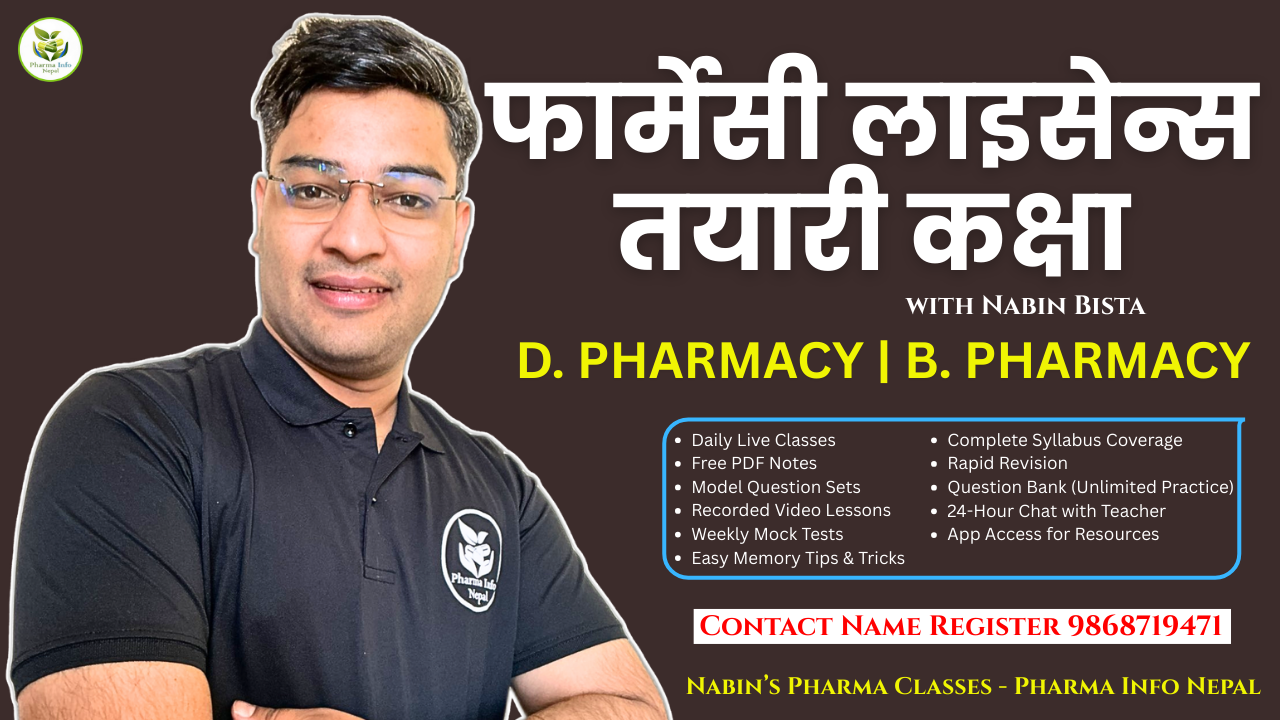
Nepal Pharmacy Council License Exam MCQs


Pharmaceutical Analysis MCQs

  1. Which of the following is a primary standard substance?
    a) Sodium hydroxide
    b) Potassium hydrogen phthalate (KHP)
    c) Hydrochloric acid
    d) Sodium carbonate (Na₂CO₃)
    Answer: b) Potassium hydrogen phthalate (KHP)
  2. The normality of a solution is defined as:
    a) Moles of solute per liter of solution
    b) Grams of solute per liter of solution
    c) Gram equivalents of solute per liter of solution
    d) Moles of solute per kilogram of solvent
    Answer: c) Gram equivalents of solute per liter of solution
  3. In a non-aqueous titration, glacial acetic acid is commonly used as:
    a) Base
    b) Acidic solvent
    c) Oxidizing agent
    d) Indicator
    Answer: b) Acidic solvent
  4. The indicator used in argentometric titration is:
    a) Phenolphthalein
    b) Methyl orange
    c) Potassium chromate
    d) Thymol blue
    Answer: c) Potassium chromate
  5. In complexometric titration, EDTA is used as:
    a) Oxidizing agent
    b) Reducing agent
    c) Chelating agent
    d) Primary standard
    Answer: c) Chelating agent
  6. In potentiometric titration, the endpoint is determined by:
    a) Change in conductivity
    b) Change in pH or potential
    c) Color change of indicator
    d) Formation of precipitate
    Answer: b) Change in pH or potential
  7. Which titration is suitable for assay of sodium chloride?
    a) Acid-base titration
    b) Precipitation titration
    c) Redox titration
    d) Complexometric titration
    Answer: b) Precipitation titration
  8. The titration method used to determine ascorbic acid content is:
    a) Iodimetry
    b) Argentometry
    c) EDTA titration
    d) Alkalimetry
    Answer: a) Iodimetry
  9. In redox titration, potassium permanganate acts as:
    a) Reducing agent
    b) Oxidizing agent
    c) Chelating agent
    d) Precipitating agent
    Answer: b) Oxidizing agent
  10. Back titration is used when:
    a) Endpoint is not sharp
    b) Sample is insoluble in solvent
    c) Sample reacts slowly
    d) All of the above
    Answer: d) All of the above
  11. Phenolphthalein is colorless in:
    a) Acidic medium
    b) Neutral medium
    c) Alkaline medium
    d) All of the above
    Answer: a) Acidic medium
  12. The pH range of methyl orange is:
    a) 3.1–4.4
    b) 4.0–6.5
    c) 6.0–7.5
    d) 8.0–9.8
    Answer: a) 3.1–4.4
  13. A suitable indicator for titration of a strong acid with a weak base is:
    a) Phenolphthalein
    b) Methyl orange
    c) Bromothymol blue
    d) Cresol red
    Answer: b) Methyl orange
  14. The theory that explains indicator color change is:
    a) Ostwald’s theory
    b) Nernst equation
    c) Gibbs adsorption theory
    d) Kohlrausch’s law
    Answer: a) Ostwald’s theory
  15. The color change of phenolphthalein is due to:
    a) Redox reaction
    b) Structural change in ionized form
    c) Formation of chelates
    d) Formation of precipitate
    Answer: b) Structural change in ionized form
  16. The indicator used in iodometric titration is:
    a) Starch
    b) Methyl orange
    c) Phenolphthalein
    d) Ferroin
    Answer: a) Starch
  17. The suitable indicator for weak acid-strong base titration is:
    a) Methyl orange
    b) Phenolphthalein
    c) Congo red
    d) Methyl red
    Answer: b) Phenolphthalein
  18. In a redox titration using potassium dichromate, the external indicator used is:
    a) Diphenylamine
    b) Phenolphthalein
    c) Bromocresol green
    d) Congo red
    Answer: a) Diphenylamine
  19. An example of adsorption indicator is:
    a) Starch
    b) Potassium chromate
    c) Fluorescein
    d) Methyl orange
    Answer: c) Fluorescein
  20. Internal indicators are added:
    a) To the standard solution
    b) To the sample solution
    c) To both solutions
    d) Separately after titration
    Answer: b) To the sample solution
  21. The principle of UV-Visible spectroscopy is:
    a) Absorption of infrared radiation
    b) Absorption of UV/visible radiation
    c) Emission of X-rays
    d) Diffraction of light
    Answer: b) Absorption of UV/visible radiation
  22. The Beer-Lambert law relates absorbance with:
    a) Concentration and wavelength
    b) Concentration and path length
    c) Concentration and temperature
    d) Concentration and solvent polarity
    Answer: b) Concentration and path length
  23. In infrared spectroscopy, the fingerprint region is:
    a) 4000–2500 cm⁻¹
    b) 2500–1500 cm⁻¹
    c) 1500–400 cm⁻¹
    d) 5000–4000 cm⁻¹
    Answer: c) 1500–400 cm⁻¹
  24. The detector used in flame photometry is:
    a) Photodiode
    b) Photoelectric cell
    c) Thermocouple
    d) Flame ionization detector
    Answer: b) Photoelectric cell
  25. The separation principle of HPLC is based on:
    a) Mass-to-charge ratio
    b) Partition coefficient
    c) Thermal conductivity
    d) Sedimentation rate
    Answer: b) Partition coefficient
  26. A polarograph is used to measure:
    a) Electrical conductivity
    b) Diffusion current
    c) Refractive index
    d) Absorbance
    Answer: b) Diffusion current
  27. The stationary phase in gas chromatography (GC) is:
    a) Gas
    b) Solid or liquid on solid support
    c) Liquid
    d) Mobile phase only
    Answer: b) Solid or liquid on solid support
  28. The principle of atomic absorption spectroscopy (AAS) is:
    a) Emission of radiation by atoms
    b) Absorption of specific wavelength by ground-state atoms
    c) Fluorescence emission of molecules
    d) Mass-to-charge detection
    Answer: b) Absorption of specific wavelength by ground-state atoms
  29. In NMR spectroscopy, the energy transition occurs due to:
    a) Nuclear spin flipping in a magnetic field
    b) Vibrational excitation of molecules
    c) Rotation of molecules
    d) Electronic excitation
    Answer: a) Nuclear spin flipping in a magnetic field
  30. Which of the following is a non-destructive technique?
    a) UV spectroscopy
    b) IR spectroscopy
    c) NMR spectroscopy
    d) All of the above
    Answer: d) All of the above


Pharmacy License Preparation Classes Nepal


  • MCQs Extraction in Pharmacognosy for NPC License Exam and Loksewa
  • Clinical Pharmacy MCQs for Nepal Pharmacy Council License Exam and Loksewa
Tags: LicenseMCQsPharmaceutical Analysis MCQsQuestions
Previous Post

Why Sodium Bicarbonate Tablets Are Used in Kidney Patients

Next Post

Why is Paracetamol Combined with Caffeine?

Pharma Info Nepal

Pharma Info Nepal

Pharma Info Nepal is Nepal’s leading platform dedicated to pharmacy professionals, students, and healthcare workers. Our mission is to empower the pharmacy community with timely updates, verified job opportunities, exam preparation resources (NPC & Loksewa), scholarships, research insights, and professional guidelines. Trusted by thousands, Pharma Info Nepal is committed to sharing accurate and timely updates from the DDA, NPC, MoHP, and other regulatory bodies, ensuring every pharmacist and pharmacy student stays informed and prepared for career growth. with a vision to educate, inspire, and connect, our team is working to create Nepal’s most reliable pharmacy information hub. Join us to learn, grow, and lead in Nepal’s pharmacy sector. Pharma Info Nepal – Nepal’s No.1 Pharmacy Blog

Related Posts

Quality Assurance MCQs Pharma Info Neppal
License

Quality Assurance MCQs for Pharmacy License Loksewa and Entrance Exam

November 19, 2025
Classification of Antidepressant Drugs
Pharmacology

Classification of Antidepressant Drugs

October 4, 2025
List of Bachelor’s Pharmacy Colleges in Nepal (Updated)
B Pharmacy

List of Bachelor’s Pharmacy Colleges in Nepal (Updated)

October 3, 2025
Levonorgestrel: Emergency Contraceptive Pill (Morning-After Pill)
Study Materials

Levonorgestrel: Emergency Contraceptive Pill (Morning-After Pill)

October 3, 2025
Fire Extinguishers: Composition, Colour Codes, Uses, and Limitations
Pharmacy Notes

Fire Extinguishers: Composition, Colour Codes, Uses, and Limitations

October 3, 2025
Instrumentation of Polarography
Pharmacy Notes

Polarography Principle Instrumentation and Application

October 1, 2025
Load More
Next Post
Why is Paracetamol Combined with Caffeine?

Why is Paracetamol Combined with Caffeine?

Recommended

Vacancy Announcement for Pharmacy officer and Pharmacy Assistant Pokhara University Teaching Hospital 

Vacancy Announcement for Pharmacy officer and Pharmacy Assistant Pokhara University Teaching Hospital 

January 1, 2026
Vacancy Announcement Pharmacy Instructor CTEVT Various Colleges

Vacancy Announcement Pharmacy Instructor CTEVT Various Colleges

December 23, 2025
Vacancy Announcement Pharmacy Instructor CTEVT

Vacancy Announcement Pharmacy Instructor CTEVT

December 23, 2025
Nepal Pharmacy Council Announces 30th Name Registration Examination: Application Open 

Nepal Pharmacy Council Announces 30th Name Registration Examination: Application Open 

December 22, 2025
Pharmacy Supervisor Loksewa Syllabus Koshi Province

Pharmacy Supervisor Loksewa Syllabus Koshi Province

December 16, 2025
  • Facebook
  • Twitter
  • LinkedIn
  • YouTube
  • Instagram

About Pharma Info Nepal

Pharma Info Nepal is a dedicated platform led by Nabin Bista, focused on empowering pharmacy students and professionals in Nepal. We provide high-quality educational resources, exam preparation materials, and professional guidance for pharmacy licensure exams and beyond. Our mission is to uplift the pharmacy profession in Nepal by fostering knowledge, skills, and excellence in pharmaceutical practice.

Explore our services, stay updated on pharmacy trends, and join a community striving for innovation and professionalism in healthcare.

IMPORTANT INFORMATION

All content available on this website, including text, images, files, and other resources, is strictly protected under applicable copyright and intellectual property laws. Any reuse, reproduction, or redistribution of materials without prior written permission from Pharma Info Nepal is prohibited and may result in legal action.

Pharma Info Nepal operates as a registered company dedicated to maintaining the authenticity and integrity of its content and services.

Thank you for respecting our policies and supporting our mission to advance pharmacy education and practice.

CATEGORIES

  • B Pharmacy
  • Colleges
  • D Pharmacy
  • Downloads
  • License
  • Loksewa
  • M Pharmacy
  • Medicinal Chemistry
  • Notice
  • Nursing
  • Pharmacognosy
  • Pharmacology
  • Pharmacy Notes
  • Questions
  • Scholarship
  • Study Materials
  • Syllabus
  • Updates
  • Vacancy

DOWNLOADS

Pharmacy Book 

Pharmacy Act and Guidelines

About Pharma Info Nepal

About Admin

  • Home
  • Vacancy
  • Courses
  • License
  • Loksewa
  • Questions
  • Downloads
  • Pharmacy Books
  • Pharmacy Notes

© 2025 Pharma Info Nepal Pvt.Ltd | All Rights Reserved

error:
No Result
View All Result
  • Home
  • Courses
  • Questions
  • Downloads
  • About Pharma Info Nepal 

© 2025 Pharma Info Nepal Pvt.Ltd | All Rights Reserved