Classification of Beta-Blockers
Classification of Beta-Blockers: Types, Examples, and Uses
Beta-blockers, also known as β-adrenergic receptor blockers, are drugs that block the effects of catecholamines, particularly adrenaline and noradrenaline, at beta-adrenergic receptors. They are widely used in the treatment of hypertension, angina pectoris, cardiac arrhythmias, heart failure, and other cardiovascular conditions.
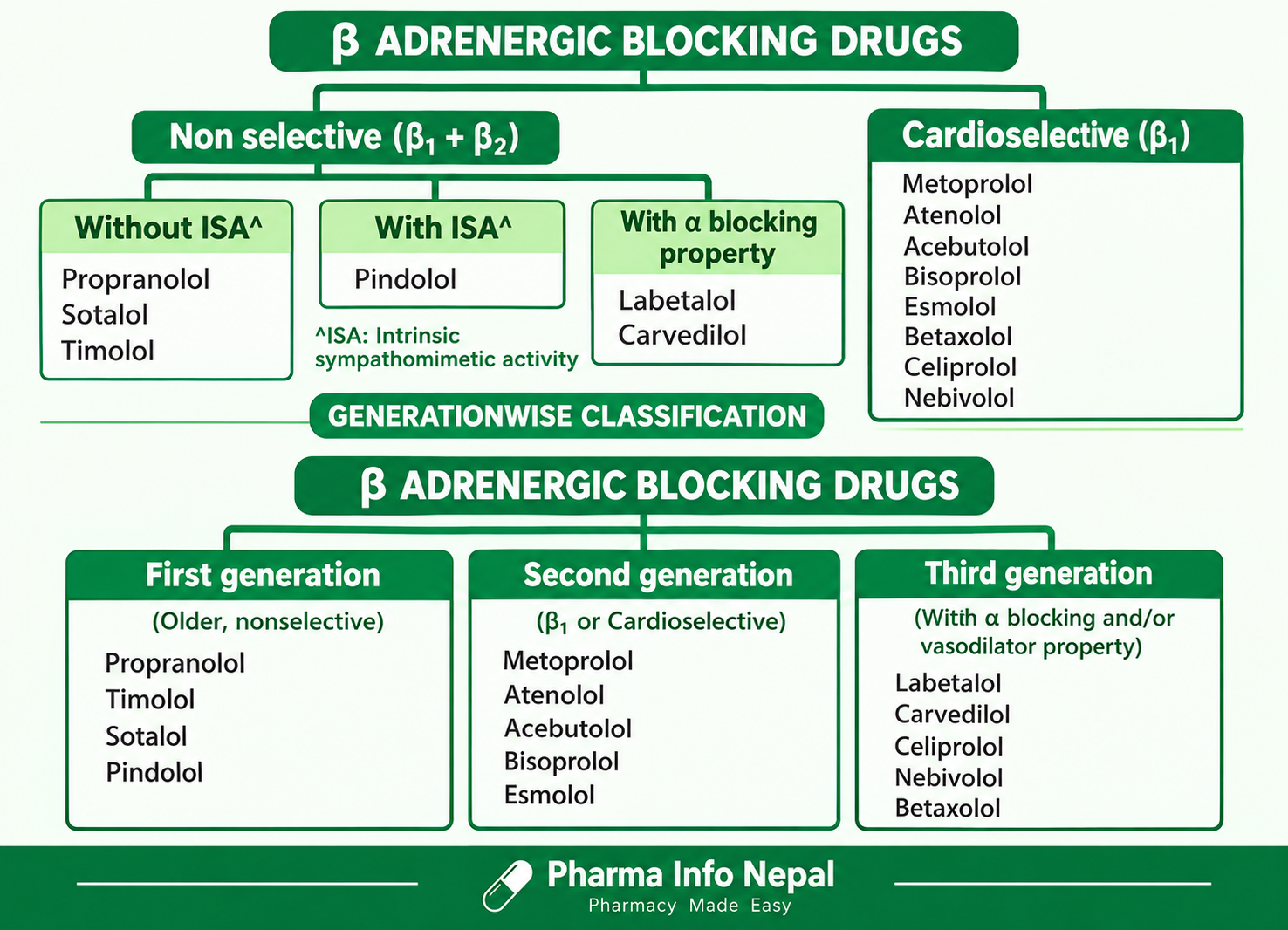
Beta-blockers can be classified according to receptor selectivity, intrinsic sympathomimetic activity, additional vasodilating properties, and duration of action.
1. Classification Based on Beta-Receptor Selectivity
A. Non-selective beta-blockers
These drugs block both β₁ and β₂ adrenergic receptors.
Examples:
- Propranolol
- Nadolol
- Timolol
- Pindolol
- Sotalol
Uses: Hypertension, angina, certain arrhythmias, glaucoma (timolol), and other specific indications.
B. Cardioselective beta-blockers (β₁-selective)
These drugs preferentially block β₁ receptors, which are mainly present in the heart. Their selectivity decreases at higher doses.
Examples:
- Atenolol
- Metoprolol
- Bisoprolol
- Esmolol
- Betaxolol
- Nebivolol
Uses: Hypertension, angina, selected arrhythmias, and chronic heart failure with specific agents such as bisoprolol and metoprolol succinate.
2. Classification Based on Intrinsic Sympathomimetic Activity (ISA)
Intrinsic sympathomimetic activity refers to the ability of a beta-blocker to produce partial stimulation of beta receptors while preventing stronger stimulation by endogenous catecholamines.
A. Beta-blockers with ISA
Examples:
- Pindolol
- Acebutolol
- Oxprenolol
- Celiprolol
B. Beta-blockers without ISA
Examples:
- Propranolol
- Atenolol
- Metoprolol
- Bisoprolol
- Timolol
- Nadolol
Exam point: Pindolol is a classic example of a beta-blocker with intrinsic sympathomimetic activity.
3. Classification Based on Additional Vasodilating Properties
A. Beta-blockers without prominent additional vasodilating action
Examples:
- Propranolol
- Atenolol
- Metoprolol
- Bisoprolol
- Nadolol
B. Beta-blockers with additional vasodilating properties
Examples:
- Carvedilol — blocks β₁, β₂, and α₁ receptors.
- Labetalol — blocks α₁ and β receptors.
- Nebivolol — promotes nitric oxide-mediated vasodilation.
- Celiprolol — has β₁-blocking and β₂-agonist properties.
Exam point: Carvedilol and labetalol are important examples of beta-blockers that also block alpha-1 receptors.
4. Classification Based on Duration of Action
Duration varies with dose, formulation, route of administration, and individual patient factors. The following groups are approximate rather than universally standardized.
| Duration | Examples | Important information |
|---|---|---|
| Ultra-short-acting | Esmolol | IV drug; half-life approximately 9 minutes |
| Short-acting | Propranolol, immediate-release | Half-life approximately 3–6 hours |
| Intermediate-acting | Metoprolol, immediate-release | Half-life approximately 3–7 hours |
| Longer-acting | Atenolol | Half-life approximately 6–9 hours; effects can last around 24 hours |
| Long-acting | Nadolol | Half-life approximately 20–24 hours |
| Long-acting | Betaxolol | Half-life approximately 14–22 hours |
| Long-acting | Bisoprolol | Half-life approximately 10–12 hours |
5. Classification Based on Additional Pharmacological Properties
| Property | Examples |
|---|---|
| β₁-selective blockers | Atenolol, metoprolol, bisoprolol |
| Non-selective blockers | Propranolol, nadolol, timolol |
| Alpha-1 and beta blockers | Carvedilol, labetalol |
| Beta-blockers with ISA | Pindolol, acebutolol |
| Beta-blocker with nitric oxide-mediated vasodilation | Nebivolol |
| Beta-blocker with potassium-channel-blocking antiarrhythmic activity | Sotalol |
6. Therapeutic Uses of Beta-Blockers
Beta-blockers are used in several clinical conditions:
- Hypertension: Selected beta-blockers help reduce blood pressure.
- Angina pectoris: Reduce heart rate and myocardial oxygen demand.
- Cardiac arrhythmias: Help control heart rate in selected tachyarrhythmias.
- Heart failure: Bisoprolol, carvedilol, and sustained-release metoprolol succinate improve outcomes in appropriate patients with heart failure with reduced ejection fraction.
- Post-myocardial infarction: Used in selected patients according to clinical indication.
- Glaucoma: Timolol reduces aqueous humour production and intraocular pressure.
- Hyperthyroidism: Propranolol helps control symptoms such as tremor and tachycardia.
- Migraine prophylaxis: Propranolol and selected other beta-blockers may be used to prevent migraine.
- Essential tremor: Propranolol is a commonly used option.
7. Important Adverse Effects and Precautions
Common adverse effects include:
- Bradycardia
- Hypotension
- Fatigue
- Dizziness
- Exercise intolerance
- Sexual dysfunction in some patients
Important precautions:
- Non-selective beta-blockers may cause bronchospasm, particularly in patients with asthma.
- Beta-blockers may mask some symptoms of hypoglycaemia, especially tachycardia.
- Abrupt discontinuation can cause rebound tachycardia, worsening angina, or other cardiovascular complications.
- They should be used according to the patient’s condition and clinical guidance.
8. Important MCQ Points for Pharmacy and Loksewa Exams
- Ultra-short-acting beta-blocker: Esmolol.
- Non-selective beta-blocker: Propranolol.
- Cardioselective beta-blocker: Atenolol.
- Beta-blocker with ISA: Pindolol.
- Beta-blocker with alpha-1-blocking activity: Carvedilol.
- Beta-blocker used in glaucoma: Timolol.
- Beta-blocker with nitric oxide-mediated vasodilating activity: Nebivolol.
- Beta-blocker with potassium-channel-blocking activity: Sotalol.
- Beta-blockers commonly used in heart failure with reduced ejection fraction: Bisoprolol, carvedilol, and metoprolol succinate.
Beta-blockers are an important class of cardiovascular drugs. Their classification according to receptor selectivity, ISA, vasodilating properties, and duration of action helps students understand their pharmacological differences and clinical uses. For pharmacy licensing and Loksewa examinations, focus particularly on propranolol, atenolol, metoprolol, esmolol, pindolol, carvedilol, labetalol, nebivolol, timolol, and sotalol.