Classification of Antihypertensive Drugs
Classification of Antihypertensive Drugs: Complete Guide for Pharmacy Students
High blood pressure (hypertension) is one of the leading risk factors for cardiovascular diseases such as stroke, myocardial infarction, heart failure, and chronic kidney disease. Antihypertensive drugs help reduce blood pressure by acting through different mechanisms, including reducing blood volume, relaxing blood vessels, decreasing cardiac output, or inhibiting the renin-angiotensin-aldosterone system (RAAS).
Understanding the classification of antihypertensive drugs is essential for pharmacy students preparing for Nepal Pharmacy Council (NPC), Lok Sewa, B.Pharm, D.Pharm, and M.Pharm entrance examinations.
Classification of Antihypertensive Drugs
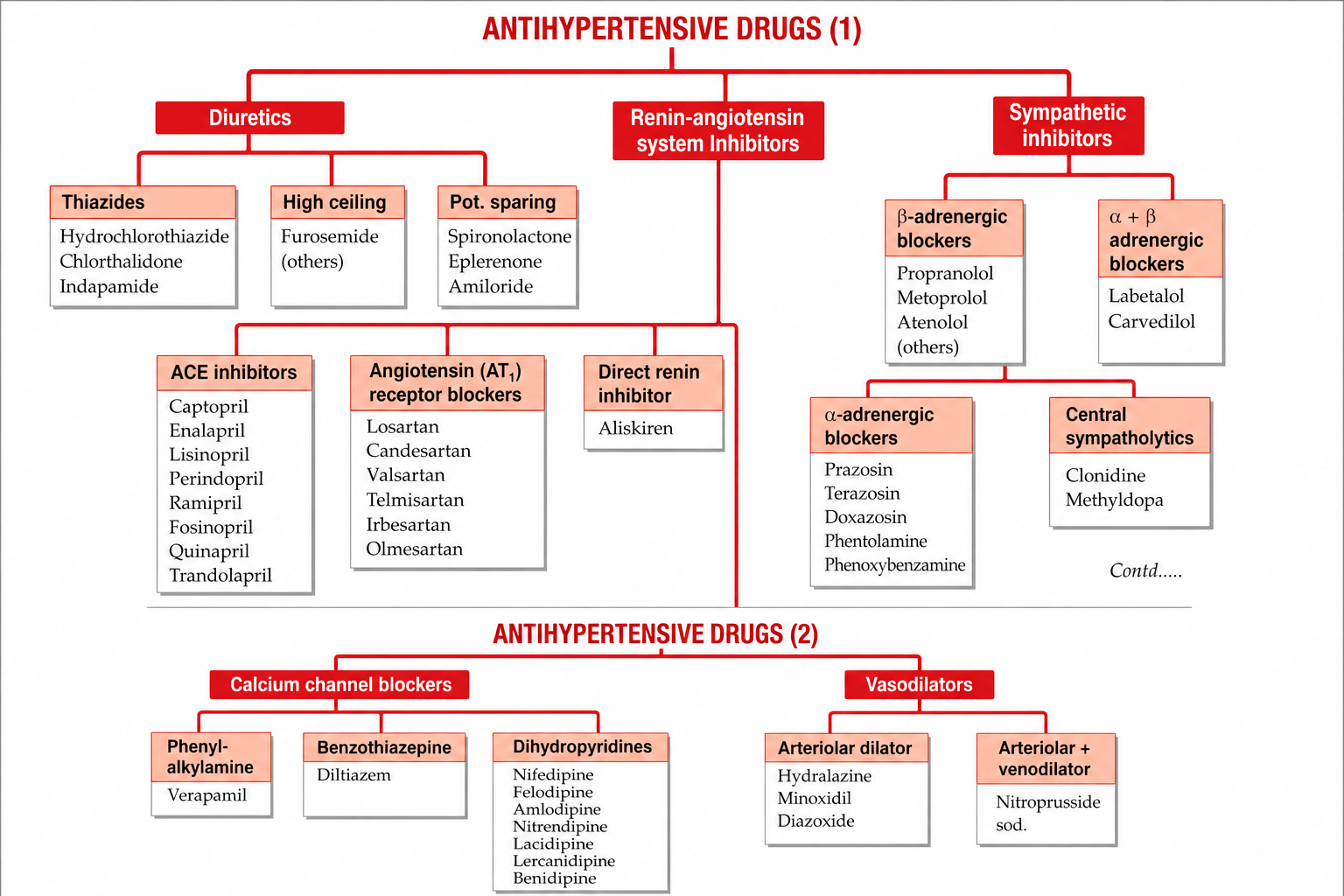
Antihypertensive drugs are broadly classified into five major groups:
- Diuretics
- Renin-Angiotensin System (RAS) Inhibitors
- Sympathetic Inhibitors
- Calcium Channel Blockers (CCBs)
- Vasodilators
1. Diuretics
Diuretics lower blood pressure by increasing sodium and water excretion, thereby reducing blood volume and cardiac output.
A. Thiazide Diuretics
Examples
- Hydrochlorothiazide
- Chlorthalidone
- Indapamide
Mechanism of Action
- Inhibit Na⁺/Cl⁻ cotransporter in the distal convoluted tubule.
- Increase sodium and water excretion.
- Long-term use decreases peripheral vascular resistance.
Clinical Uses
- First-line treatment of hypertension
- Mild edema
- Heart failure
Important Adverse Effects
- Hypokalemia
- Hyperuricemia
- Hyperglycemia
- Hyponatremia
B. High Ceiling (Loop) Diuretics
Examples
- Furosemide
- Bumetanide
- Torsemide
Mechanism
- Inhibit Na⁺-K⁺-2Cl⁻ transporter in the loop of Henle.
- Produce powerful diuresis.
Uses
- Hypertension with renal impairment
- Pulmonary edema
- Congestive heart failure
Adverse Effects
- Hypokalemia
- Ototoxicity
- Dehydration
C. Potassium-Sparing Diuretics
Examples
- Spironolactone
- Eplerenone
- Amiloride
Mechanism
- Aldosterone antagonists (Spironolactone, Eplerenone)
- ENaC blocker (Amiloride)
Advantages
- Prevent potassium loss
- Useful in resistant hypertension
Adverse Effects
- Hyperkalemia
- Gynecomastia (Spironolactone)
2. Renin-Angiotensin System (RAS) Inhibitors
These drugs inhibit the RAAS pathway responsible for vasoconstriction and sodium retention.
A. ACE Inhibitors
Examples
- Captopril
- Enalapril
- Lisinopril
- Ramipril
- Perindopril
- Quinapril
- Fosinopril
- Trandolapril
Mechanism
- Block conversion of Angiotensin I to Angiotensin II.
- Increase bradykinin levels.
- Cause vasodilation.
Clinical Uses
- Hypertension
- Heart failure
- Diabetic nephropathy
- Post-myocardial infarction
Adverse Effects
- Dry cough
- Hyperkalemia
- Angioedema
- Contraindicated in pregnancy
B. Angiotensin II (AT₁) Receptor Blockers (ARBs)
Examples
- Losartan
- Valsartan
- Candesartan
- Telmisartan
- Irbesartan
- Olmesartan
Mechanism
- Block AT₁ receptors.
- Prevent vasoconstriction and aldosterone secretion.
Advantages
- Similar efficacy to ACE inhibitors
- No bradykinin-induced cough
Adverse Effects
- Hyperkalemia
- Hypotension
- Contraindicated during pregnancy
C. Direct Renin Inhibitor
Example
- Aliskiren
Mechanism
- Directly inhibits renin activity.
- Prevents formation of Angiotensin I.
Uses
- Essential hypertension
Adverse Effects
- Hyperkalemia
- Diarrhea
- Hypotension
3. Sympathetic Inhibitors
These drugs decrease sympathetic nervous system activity, reducing heart rate, cardiac output, and vascular resistance.
A. β-Adrenergic Blockers (Beta Blockers)
Examples
- Propranolol
- Atenolol
- Metoprolol
Mechanism
- Block β₁ receptors in the heart.
- Decrease heart rate and cardiac output.
- Reduce renin secretion.
Uses
- Hypertension
- Angina
- Arrhythmias
- Heart failure (selected agents)
Adverse Effects
- Bradycardia
- Fatigue
- Bronchospasm (non-selective agents)
B. α + β Adrenergic Blockers
Examples
- Labetalol
- Carvedilol
Mechanism
- Block both α and β receptors.
- Reduce heart rate and peripheral resistance.
Uses
- Hypertensive emergencies
- Heart failure
- Pregnancy-induced hypertension (Labetalol)
C. α-Adrenergic Blockers
Examples
- Prazosin
- Terazosin
- Doxazosin
- Phentolamine
- Phenoxybenzamine
Mechanism
- Block α₁ receptors.
- Cause vasodilation.
Uses
- Hypertension
- Benign prostatic hyperplasia (BPH)
Adverse Effects
- Orthostatic hypotension
- Dizziness
- First-dose syncope
D. Central Sympatholytics
Examples
- Clonidine
- Methyldopa
Mechanism
- Stimulate central α₂ receptors.
- Reduce sympathetic outflow.
Uses
- Resistant hypertension
- Hypertension during pregnancy (Methyldopa)
Adverse Effects
- Sedation
- Dry mouth
- Rebound hypertension (Clonidine)
4. Calcium Channel Blockers (CCBs)
Calcium channel blockers inhibit L-type calcium channels, causing vasodilation and reduced myocardial contractility.
A. Phenylalkylamine
Example
- Verapamil
Characteristics
- Greater effect on the heart
- Used in hypertension and arrhythmias
B. Benzothiazepine
Example
- Diltiazem
Characteristics
- Intermediate effect on heart and blood vessels
C. Dihydropyridines
Examples
- Amlodipine
- Nifedipine
- Felodipine
- Nicardipine
- Lercanidipine
- Lacidipine
- Benidipine
Characteristics
- Predominantly vasodilators
- Common first-line antihypertensive drugs
Adverse Effects
- Peripheral edema
- Flushing
- Headache
- Reflex tachycardia (short-acting agents)
5. Vasodilators
These drugs directly relax vascular smooth muscle.
A. Arteriolar Dilators
Examples
- Hydralazine
- Minoxidil
- Diazoxide
Mechanism
- Dilate arterioles.
- Reduce peripheral vascular resistance.
Uses
- Resistant hypertension
- Hypertensive emergencies (Hydralazine)
Adverse Effects
- Reflex tachycardia
- Fluid retention
- Hypertrichosis (Minoxidil)
- Drug-induced lupus (Hydralazine)
B. Arteriolar and Vasodilator
Example
- Sodium Nitroprusside
Mechanism
- Releases nitric oxide (NO).
- Dilates both arteries and veins.
Uses
- Hypertensive emergencies
- Acute heart failure
Important Adverse Effect
- Cyanide toxicity during prolonged infusion
Summary Table
| Class | Main Examples | Mechanism |
|---|---|---|
| Thiazide Diuretics | Hydrochlorothiazide, Chlorthalidone | Increase sodium and water excretion |
| Loop Diuretics | Furosemide | Potent diuresis |
| Potassium-Sparing Diuretics | Spironolactone, Amiloride | Prevent potassium loss |
| ACE Inhibitors | Enalapril, Ramipril | Block Angiotensin I → II conversion |
| ARBs | Losartan, Telmisartan | Block AT₁ receptors |
| Direct Renin Inhibitor | Aliskiren | Inhibits renin |
| Beta Blockers | Atenolol, Metoprolol | Reduce heart rate and renin release |
| Alpha Blockers | Prazosin | Vasodilation |
| Central Sympatholytics | Clonidine, Methyldopa | Reduce sympathetic outflow |
| Calcium Channel Blockers | Amlodipine, Verapamil, Diltiazem | Block calcium channels |
| Vasodilators | Hydralazine, Minoxidil, Nitroprusside | Direct vascular smooth muscle relaxation |
High-Yield Points for Exams
- Thiazide diuretics are considered first-line drugs for uncomplicated hypertension.
- ACE inhibitors commonly cause a dry cough due to increased bradykinin.
- ARBs do not usually cause cough and are suitable alternatives when ACE inhibitors are not tolerated.
- Spironolactone may cause gynecomastia and hyperkalemia.
- Methyldopa and Labetalol are preferred antihypertensive drugs during pregnancy.
- Amlodipine is one of the most commonly prescribed calcium channel blockers for hypertension.
- Sodium nitroprusside is mainly used for hypertensive emergencies.
- Hydralazine may cause drug-induced lupus erythematosus.
- Minoxidil can cause hypertrichosis (excessive hair growth).
- Aliskiren is the only clinically used direct renin inhibitor.
Antihypertensive drugs are classified based on their mechanism of action into diuretics, RAS inhibitors, sympathetic inhibitors, calcium channel blockers, and vasodilators. A clear understanding of their classification, mechanisms, examples, clinical uses, and adverse effects is essential for pharmacy practice and competitive examinations such as the Nepal Pharmacy Council License Exam, Lok Sewa, D.Pharm, B.Pharm, and M.Pharm entrance exams.