• Privacy Policy
  • Terms and Conditions
  • Contact
Thursday, March 26, 2026
Pharma Info Nepal
  • Home
  • Vacancy
  • Courses
  • License
  • Loksewa
  • Questions
  • Downloads
  • Pharmacy Books
    • Pharmacy Act and Guidelines
    • Study Materials
  • Pharmacy Notes
    • B Pharmacy
    • D Pharmacy
No Result
View All Result
  • Home
  • Vacancy
  • Courses
  • License
  • Loksewa
  • Questions
  • Downloads
  • Pharmacy Books
    • Pharmacy Act and Guidelines
    • Study Materials
  • Pharmacy Notes
    • B Pharmacy
    • D Pharmacy
No Result
View All Result
Pharma Info Nepal
No Result
View All Result
Home Study Materials

Clinical Trials of Drugs 

Clinical Trials of Drugs 

Pharma Info Nepal by Pharma Info Nepal
October 2, 2021
in Study Materials
0
Clinical Trials of Drugs 
510
VIEWS
Share on FacebookShare on Twitter
ADVERTISEMENT

Clinical Trials of Drugs 

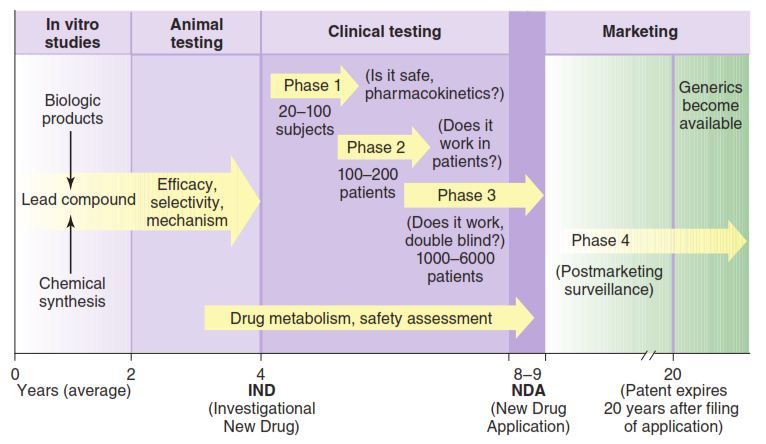
Human testing of new drugs in the United States requires approval by institutional committees that monitor the ethical (informed consent, patient safety) and scientific aspects (study design, statistical power) of the proposed tests. Such testing also requires the prior approval by the FDA of an Investigational New Drug Exemption application (IND), which is submitted by the manufacturer to the FDA. The IND includes all the preclinical data collected up to the time of submission and the detailed proposal for clinical trials. The major clinical testing process is usually divided into 3 phases that are carried out to provide information for a New Drug Application (NDA). The NDA includes all the results of preclinical and clinical testing and constitutes the request for FDA approval of general marketing of the new agent for prescription use. A fourth phase of study (the surveillance phase) follows NDA approval. In particularly lethal conditions, the FDA may permit carefully monitored treatment of patients before phases 2 and 3 are completed.

Phase 1

A phase 1 trial consists of careful evaluation of the dose-response relationship and the pharmacokinetics of the new drug in a small number of normal human volunteers (eg, 20–100). An exception is the phase 1 trials of cancer chemotherapeutic agents and other highly toxic drugs; these are carried out by administering the agents to volunteer patients with the target disease. In phase 1 studies, the acute effects of the agent are studied over a broad range of dosages, starting with one that produces no detectable effect and progressing to one that produces either a significant physiologic response or a very minor toxic effect.

Phase 2

A phase 2 trial involves evaluation of a drug in a moderate number of sick patients (eg, 100–200) with the target disease. A placebo or positive control drug is included in a single-blind or double-blind design. The study is carried out under very carefully controlled conditions, and patients are closely monitored, often in a hospital research ward. The goal is to determine whether the agent has the desired efficacy (ie, produces adequate therapeutic response) at doses that are tolerated by sick patients. Detailed data are collected regarding the pharmacokinetics and pharmacodynamics of the drug in this patient population.

Phase 3

A phase 3 trial usually involves many patients (eg, 1000–6000 or more, in many centers) and many clinicians who are using the drug in the manner proposed for its ultimate general use (eg, in outpatients). Such studies usually include placebo and positive controls in a double-blind crossover design. The goals are to explore further, under the conditions of the proposed clinical use, the spectrum of beneficial actions of the new drug, to compare it with placebo (negative control) and older therapy (positive control), and to discover toxicities, if any, that occur so infrequently as to be undetectable in phase 2 studies. Very large amounts of data are collected and these studies are usually very expensive. Unfortunately, relatively few phase 3 trials include the current standard of care as a positive control.If the drug successfully completes phase 3, an NDA is submitted to the FDA. If the NDA is approved, the drug can be marketed and phase 4 begins.

Phase 4

Phase 4 represents the postmarketing surveillance phase of evaluation, in which it is hoped that toxicities that occur very infrequently will be detected and reported early enough to prevent major therapeutic disasters. Manufacturers are required to inform the FDA at regular intervals of all reported untoward drug reactions. Unlike the first 3 phases, phase 4 has not been rigidly regulated by the FDA in the past. Because so many drugs have been found to be unacceptably toxic only after they have been marketed, there is considerable current interest in making phase 4 surveillance more consistent, effective, and informative.
 

Clinical Trials of Drugs 
Fig: The development and testing process required to bring a new drug to market in the United States. Some requirements may
be different for drugs used in life-threatening diseases. (Reproduced, with permission, from Katzung BG, editor: Basic & Clinical Pharmacology12th ed.)


  • FDA Approved Drugs in 2020
  • FDA Approves First COVID-19 Vaccine Pfizer-BioNTech


Tags: Clinical Trials of DrugsPharmacy Updates
Previous Post

WHO Model List of Essential Medicines 22nd List (2021)

Next Post

Pharmacology 35 MCQs for Various Exams 

Pharma Info Nepal

Pharma Info Nepal

Pharma Info Nepal is Nepal’s leading platform dedicated to pharmacy professionals, students, and healthcare workers. Our mission is to empower the pharmacy community with timely updates, verified job opportunities, exam preparation resources (NPC & Loksewa), scholarships, research insights, and professional guidelines. Trusted by thousands, Pharma Info Nepal is committed to sharing accurate and timely updates from the DDA, NPC, MoHP, and other regulatory bodies, ensuring every pharmacist and pharmacy student stays informed and prepared for career growth. with a vision to educate, inspire, and connect, our team is working to create Nepal’s most reliable pharmacy information hub. Join us to learn, grow, and lead in Nepal’s pharmacy sector. Pharma Info Nepal – Nepal’s No.1 Pharmacy Blog

Related Posts

Updated Guidelines on the Treatment of Drug-Susceptible and Drug-Resistant TB
Downloads

Updated Guidelines on the Treatment of Drug-Susceptible and Drug-Resistant TB

February 10, 2026
Classification of Antidepressant Drugs
Pharmacology

Classification of Antidepressant Drugs

October 4, 2025
Levonorgestrel: Emergency Contraceptive Pill (Morning-After Pill)
Study Materials

Levonorgestrel: Emergency Contraceptive Pill (Morning-After Pill)

October 3, 2025
Fire Extinguishers: Composition, Colour Codes, Uses, and Limitations
Pharmacy Notes

Fire Extinguishers: Composition, Colour Codes, Uses, and Limitations

October 3, 2025
Instrumentation of Polarography
Pharmacy Notes

Polarography Principle Instrumentation and Application

October 1, 2025
Polarimetry Principle Instrumentation and Applications
Pharmacy Notes

Polarimetry Principle Instrumentation and Applications

October 1, 2025
Load More
Next Post
Pharmacology 35 MCQs for Various Exams 

Pharmacology 35 MCQs for Various Exams 

Discussion about this post

Recommended

Vacancy Announcement for Pharmacy Assistant Rapti Academy of Health Sciences

Vacancy Announcement for Pharmacy Assistant Rapti Academy of Health Sciences

March 11, 2026
Vacancy Announcement for Pharmacist Vega Pharmaceuticals

Vacancy Announcement for Pharmacist Vega Pharmaceuticals

February 27, 2026
Pharmacy Loksewa Vacancy Gandaki Pradesh

Pharmacy Loksewa Vacancy Gandaki Pradesh

February 26, 2026
Nepal Pharmacy Council License Exam Model Questions Diploma in Pharmacy

Nepal Pharmacy Council License Exam Model Questions Diploma in Pharmacy

February 23, 2026
Nepal Pharmacy Council License Exam Model Questions Bachelor in Pharmacy

Nepal Pharmacy Council License Exam Model Questions Bachelor in Pharmacy

February 23, 2026
  • Facebook
  • Twitter
  • LinkedIn
  • YouTube
  • Instagram

About Pharma Info Nepal

Pharma Info Nepal is a dedicated platform led by Nabin Bista, focused on empowering pharmacy students and professionals in Nepal. We provide high-quality educational resources, exam preparation materials, and professional guidance for pharmacy licensure exams and beyond. Our mission is to uplift the pharmacy profession in Nepal by fostering knowledge, skills, and excellence in pharmaceutical practice.

Explore our services, stay updated on pharmacy trends, and join a community striving for innovation and professionalism in healthcare.

IMPORTANT INFORMATION

All content available on this website, including text, images, files, and other resources, is strictly protected under applicable copyright and intellectual property laws. Any reuse, reproduction, or redistribution of materials without prior written permission from Pharma Info Nepal is prohibited and may result in legal action.

Pharma Info Nepal operates as a registered company dedicated to maintaining the authenticity and integrity of its content and services.

Thank you for respecting our policies and supporting our mission to advance pharmacy education and practice.

CATEGORIES

  • B Pharmacy
  • Colleges
  • D Pharmacy
  • Downloads
  • License
  • Loksewa
  • M Pharmacy
  • Medicinal Chemistry
  • Notice
  • Nursing
  • Pharmacognosy
  • Pharmacology
  • Pharmacy Notes
  • Questions
  • Scholarship
  • Study Materials
  • Syllabus
  • Updates
  • Vacancy

DOWNLOADS

Pharmacy Book 

Pharmacy Act and Guidelines

About Pharma Info Nepal

About Admin

  • Home
  • Vacancy
  • Courses
  • License
  • Loksewa
  • Questions
  • Downloads
  • Pharmacy Books
  • Pharmacy Notes

© 2025 Pharma Info Nepal Pvt.Ltd | All Rights Reserved

error:
No Result
View All Result
  • Home
  • Courses
  • Questions
  • Downloads
  • About Pharma Info Nepal 

© 2025 Pharma Info Nepal Pvt.Ltd | All Rights Reserved